Showing posts with label Art. Show all posts

Sunday, May 1, 2011

Easter in the Country

Last weekend, we were invited to the country, to Terra Alta, a beautiful rural region, two hours south of Barcelona, to spend Easter with friends - Nuria and Pau - and their families. 


Upon arrival in Gandesa, we realized why Nuria goes to her pueblo so often: the lush green flora, dramatic mountain landscape and tranquil country roads make Terra Alta a true Medeterrian Paradise:


We were greeted by her exhuberant father, who gave us a tour of the world though his liquor collection:


And by her mother, who made several traditional meals rivaling only those my grandmother's Texas cooking. Unfortunately, we didn't snap any photos of the squid with white beans or slow-roasted chicken or home-made lasagna with beschamel sauce she made. Cheers to Senora Cid-Puey!


The next day, we headed to Pau's family house in Horta de Sant Joan, a town famous for it's beauty but also for having hosted Pablo Picasso for several months in 1898 when he and a friend lived in a cave and painted like madmen. This could have been the view from their cave:


Before arriving, we stopped off in a nearby medieval town, Valderrobres, to see a traditional Good Friday procession of Nazerenos:


As soon we saw these white cone hats, Nuria and I were ready run for the hills:


Nazarenos pre-date the KKK by a thousand years, but they still have a dominating, oppressive presence, especially, when the scary creatures start banging very loudly, in unison, on large drums:


Fortunately, we had a nice, cozy house to go home to. This is Pau, his mother and his 91-year-old grandfather:


On Easter morning, there were no colored eggs or hunts of any kind, but the Bunny did come:


And we ate him!


During the reminder of the five hour lunch, Ted received more hazing by the Fortuno brothers, Pau's father and uncle, who appreciated that the American knows a thing or two about home-made liquors:


Later, we wandered around the medieval streets of Horta,


And realized why the young Picasso stayed here so long.


Sunday also happened to be the day of Horta's Annual Fast Painting Contest, which may or may not have anything to do with Picasso. Every year, hundreds of painters set up their easels around town and paint from 9am-6pm:
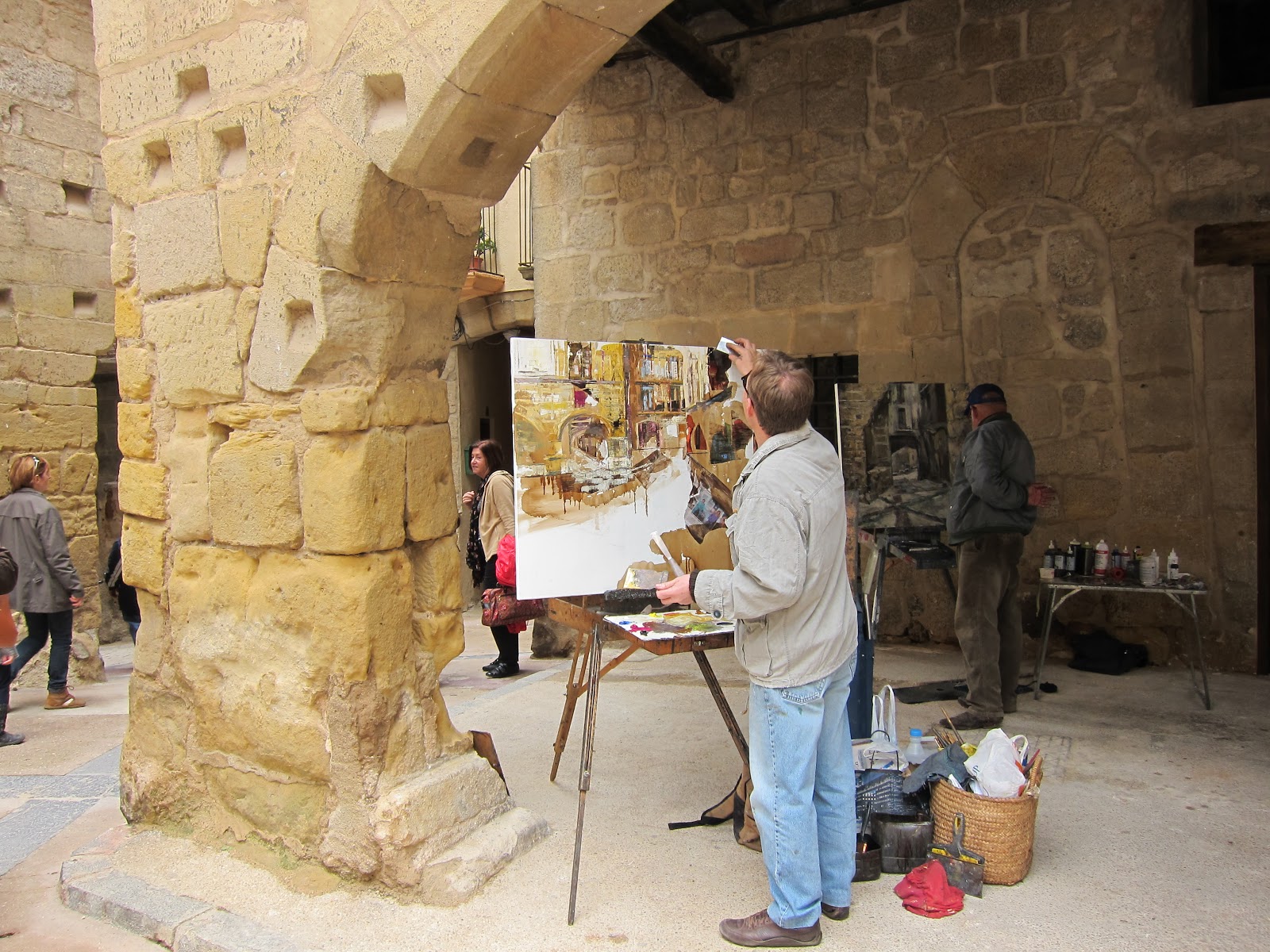

I could have stayed all day, watching the painters work and admiring Horta's beauty. Picasso once said, "Everything I know, I learned in Horta."

This is the view from Pau's kitchen window:


And this is "L'Horta de Saint Joan" by Pablo Picasso.


It was a wonderful weekend and one Easter we'll never forget!

Bones Pasqües! 
I moltes gràcies a l'Cid Puey-família i la famíliaFortuno-Estrada per un cap de setmana bonic.


Wednesday, February 9, 2011

Blossoming Street Art

Blank surfaces in this city only stay that way for a short while before someone with a spray can decides how it will be decorated, or defiled, depending on your opinions about graffiti. As I've mentioned before, street art defines the look of Barcelona. It's everywhere and always evolving. 

And it amuses me to spot new additions to our hood. Here are some of my recent favorites: 

A bird spewing tags on the side of Sant Antoni Market:


A beautifully painted boy below our apartment:


This radiator was begging for a little color:


Another interesting stencil drawing:


This poor little fellow is fed up with all the construction noise. It's loud as hell here in Gracia.


This wall, which I pass on my way to yoga, is like an ever-evolving community painting. Those cleaning it work equally as hard as those doing the coloring, and it's design changes daily.


Tuesday, December 21, 2010

Santa Maria del Mar

Hearing the Prague Symphony Orchestra and Chorus perform German composer G.F. Handel's Messiah in the Basilica de Santa Maria del Mar in Barcelona last weekend was magical. The place was packed with people - everyone dressed to the nines - who had come to hear a Christmas oratorio in the grandiose Gothic church....

 All I could think about was my Pops and how he always blasted that same music (and the a.c.) in his sedan as we drove through the Texas hill country to my grandparents house for Christmas.  


The acoustics were a bit muffled in the massive, high-ceilinged Basilica, but sound quality aside, the Santa Maria del Mar is now one of my favorite places in Barcelona.

Tucked away in the seaside corner of Ciutat Vella (the Old City), to reach the Basilica you must pass through dimly lit, rambling alleyways, dodging herds of people all the while. But upon entering, you are suddenly surrounded by amber light, space expands in all directions, time pauses. You have the sense that you've been shrunk, like Alice in Wonderland, passing into another world.

The tallest of these columns is over 100 feet high.


It's not only me that's been struck by the expansive interior of the building: Santa Maria del Mar is known to have inspired Antoni Gaudi and the arching, tree-like pillars of his architectural masterpiece, the Sagrada Familia.


We haven't actually been inside the Sagrada Familia yet, but when we go we'll report back.

Sunday, December 12, 2010

The Alhambra

Visiting the Alhambra was incredible.
Visiting the Alhambra with two architects, well that was over the top.
Had Bethany and Ed had not accompanied us, I would have left thinking - "Wow, what a delightful palace."
Instead, post-visitation we debriefed over a delicious Spanish meal the elements of excellent design, the features of Moorish architecture, the meaning of beauty, the definition of art... and yes, the fine Rioja wine we were drinking.


I was so excited to learn about the "red fortress" through the eyes an architect, I actually took notes. So, in case you too are interested in a brief overview of the palace, a timeline of Andulusia's history and Bethany's definition of beauty, then by all means, read on...


The first thing to understand is from the Roman architect Vitruvius, author of the earliest definitive theory of architecture, who said all structures should contain three components:

Durability - can it stand up robustly and remain in good condition?
Utility - is it be useful for the people using it?
Beauty - does it delight and raise the spirits?

Check, check and check. 

The Alhambra has it all.  Bethany cried upon entering the palace because she says it's the perfect design that all architects try to replicate.


It's impossible to say if the Moorsish architects of the Nasrid Dynasty had access to Vitruvius's treatise...

Wait, maybe you're wondering, "What is the Alhambra, anyway?"


In the 1200s, a fortress was built on a hill above the current town of Granada to protect the region from warring sects of the fading Muslim Empire, which occupied much of Spain (then, Andalus). As Christians established political control over the region, noble families of Muslim origin created beautiful palaces inside the walls of the former fortress (1200-1450 AD).

An interesting point here is that Muslims had a very different outlook on life than the Christians, who built rectangular, austere churches during same period. The Islamic philosophy (and I'm extrapolating) was that since Paradise is described in detail within the Koran and Allah is pleased when people are happy, good Muslims should attempt to recreate Paradise here on earth.


And so they did. Check out that detail on the walls and ceiling. 


The design of the Alhambra is surely beautiful on a small scale. Intricate wood, tile and stone work adorn almost every surface, but those fine details become part of a larger whole of repeating patterns without becoming distracting. In fact, it is breathtaking.


From every corner of the Alhambra, there is a new, alluring view. The architects, unconcerned with the bird's eye or plan view of the building, focused on how people experience space while moving through their environment.


And here is where the fine wine came in and Bethany explained her concept of beauty:

Beauty comes from two things: repetition and the path the eye travels as it looks at something. If the eye can't move easily to the next point of focus, then instinctively it doesn't like it. When the eye finds a smooth path to visually explore an object, then the thing becomes beautiful.  Repetition is also important, because it's reminds us of the rhythm of life, the beating of a heart, and makes us feel whole and connected with nature.

Another important point to appreciate is that "water is the soul of the Alhambra," and I should credit our tour guide who provided us with these interesting details:

The abundance of fountains, pools, and open channels passing between and through the interior spaces shows that water was central to the inhabitants of the Alhambra. Water was considered a gift from Allah which was to be enjoyed, but also returned to the same source from which it came. This understanding made it possible to maintain a clean water source that flowed continuously from it's source in the mountains, through house and after house, and eventually back to the river below.


The open channels running through the palaces not only provided drinking and bathing water, they also cooled and raised the humidity of the shaded courtyards, providing much needed relief in the hot, dry summers of Granada. The channels and pools also reflected light from the sun, illuminating adjacent rooms and creating meditative, dancing patterns on the walls and ceilings.  


Unfortunately, much of the original Alhambra was destroyed beginning around 1492, when the Christians decided to kick out all non-believers and even those who had converted. For the next several hundred years, the Alhambra was left to decay.


Then around 1800, the Alhambra was "rediscovered" by an American traveler Washington Irving who wrote a romantic story entitled "The Tales of the Alhambra." The Spanish monarchy began to take an interest in the site, as did the artists...

Henry Matisse visited the Alhambra in 1910, called it "marvelous" and said he felt "great emotion" while being there.


M.C. Escher, inspired by the ceramic tiling when he visited in 1922, later said these patterns evoked living creatures which continued to intrigue him throughout his life.


But again during in the 1930's, the Alhambra was yet again abandoned, this time as a result of Franco's fascist regime that wanted nothing to do with acknowledging Muslim influences on Spanish culture.

Since the 1990s the Spanish government has taken a more active role in restoring and preserving the Alhambra. Yet our tour guide estimates that over 40% of the Alhambra has not been excavated.

Who knows what secrets will be found? Until now, the story of the Alhambra is written solely by the "winners",  the Northern Europeans Christians who conquered Andalusia. It is clear that there is an entirely different account of this history and much about Muslim culture in Spain that remains to be discovered.

Monday, December 6, 2010

Parc Guell: Gaudi's Wonderland

The architects, Bethany and Ed, have abducted us on an architectural scavenger hunt / exotic food eating spree. In the past week, we've seen the Alhambra, the Sagrada Familia, Torre Agbar, many lesser known, but equally amazing feats of design, as well as, tasted everything from snails to rabbit tails. Whew!

But more on all that later.

Finally today, we enjoyed a lazy afternoon meandering around the exotic and whimsical Parc Guell created by the famous architect from Barcelona, Antoni Gaudi.


Gaudi was a fervent Catholic who said he was driven to create art as a way to collaborate with the Creator. It certainly feels that way walking around the park as the structures appear to flow in and out of the plant life.


Just as there are no perfectly straight lines on the human body, nor are there any 90 degree angles in any of Gaudi's architectural works. Beth and Ed agree he must have used many a steel beam to reinforce these gently lilting columns which carry a lot of weight:


After being awestruck by the Sagrada Familia the day before, the architects were...


 ...less than impressed with the mish-mash of odd forms in Parc Guell:


I am enamored by it and love his use of colorful ceramic tiles interspersed between the 'melting rock formations':


Even if a bit curious, Parc Guell is an inviting place that begs to be explored:


Saturday, November 20, 2010

A Dali Weekend

A few weekends ago, we rented a car and headed north to explore the most north-east region of Spain, Alt Emporda, a magical place where many prominent artists including Salvador Dali and Pablo Picasso have called home.

With the dramatic rocky landscapes, proximity to the Medeterrainian sea, and very strong wind - you can literally feel inspiration.


I've always been intrigued by the colorful, dream-like artworks of Dali, but they also seemed obscure, out-of reach.

Gala Dali


After touring the extensive collection of paintings, sculptures, installations and video art at the Dali Theatre Museum in Figueres, which Dali himself helped design before his death in 1989 (he was prolific), I still don't understand the artist or his intentions. The museum had an obvious lack of information - no audio tours, no notes on the art, no pamphlets detailing his life.


I read somewhere that whenever Dali was asked about the meaning of his art, he gave a completely different answer each time, thus igniting controversy among his critics.  I assume he wanted the viewer to decide for herself what the art meant, or maybe the art truly had a different meaning every time he contemplated it.  

After viewing at hundreds of his artworks all at once, I became comforted by them -  I am not the only one who sees crazy, sensual, scary, mixed-up, sometimes sadistic, sometimes childish images in dreams, thoughts and feelings.  His works express so many emotions and yet nothing at all tangible.

Sting Caused by the Flight of a Bee


Similarly, Alt Emporada is filled with a vibrant, unexplainable energy yet it is completely desolate. Maybe the always prevalent wind which carved the rocks gives the place a secret life.  Exploring the region by foot provided more insight into the artworks of Dali.

We hiked over the jagged rocks of Cap De Crues, an enchanting national park by the sea:


The Specter of Sex Appeal


And we found secret caverns:


Large mural inside the Theatre Museum:


Here is a view of Cadaques, a stifling small, yet romantic, town of angular white buildings.  It doesn't seem to have changed since Dali and Picasso lived here in the 1930's:


Cadaques


Portlligat, also isolated, is the bay near Cadaques where Dali and Gala worked. It also seems to have remained the same over the years:


Woman at the Window 
(my favorite):